
Agile Transformation Approach
Share
Agile Transformation Approach
Share

By: Carlos Manuel Blando y Claudia Der
In a previous article Strategy and investment in an agile environment, We highlight that the difference between the traditional approach and an agile approach in strategic planning lies fundamentally in both its conception and its execution dynamics. Now, the question that arises is How do we transform project management with an agile approach?
In The path to agility We emphasize that the way is to transform the organization towards an agile model. Now, in this article, we seek to complement with the answers to how?
How to carry out the transformation for agile project management?
We start with evaluate agile capabilities. The assessment helps reveal gaps in current agile capability maturity levels, around which the company can establish strategies and a plan to bring each capability to a higher maturity goal.
The dimensions to evaluate are:
- Leadership.
- Agile methods and tools.
- Delivery team and agile communities.
- Agile support functions and continuous improvement.
It is very important to design and define this plan, evaluate the capabilities in general terms, as well as the current state of the organization to carry out the transformation.
In the agile model there are two key aspects to consider: teams and organization:
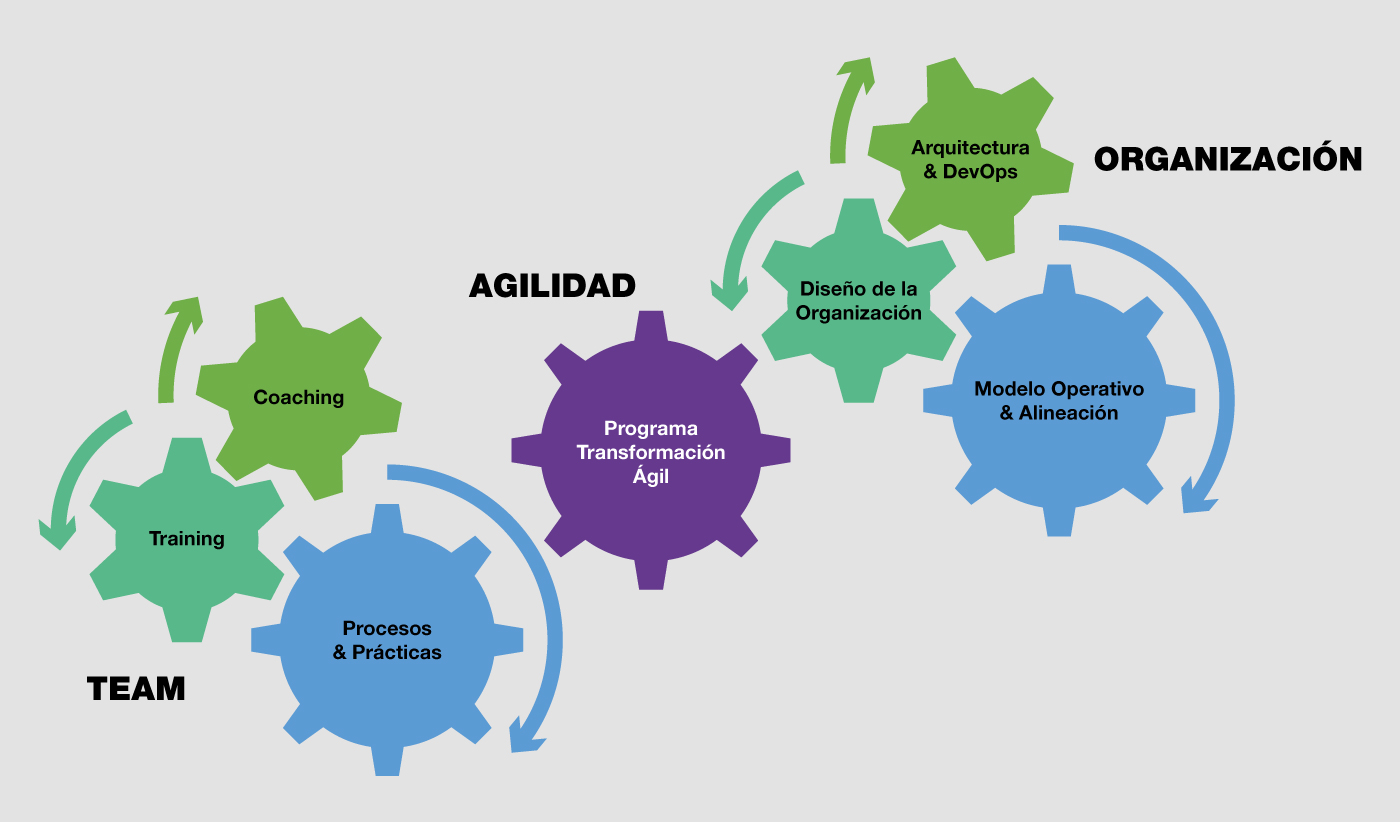
- Achieve an end-to-end operating model by integrating the business with IT. Here we recommend the model proposed by the Open Group called IT4IT.
- Achieve a technological base that allows automation and continuous delivery. Like, for example, Continuous integration & delivery – DevOps.
- Focus on agile structures with an organizational design perspective. With empowerment of business roles such as PO (Product Owner), smaller IT teams and new talent models.
- Develop Mindset coaching. Focused on building continuous improvement in the team, with support and monitoring of its adoption.
- Define agile frameworks, processes and tools. With the corresponding communication and training.
The reference agile model that we recommend, adopted by many companies internationally, is SAFe. The model Scaled Agile Framework, SAFe For its acronym in English, it allows scaling agility, not only at the level of the basic teams but throughout the company.
An organization is truly agile when it starts operating this way: discover and evaluate, prioritize, build and operate, analyze and repeat. Experimentation, collaboration, iteration, and customer focus are key themes throughout this process. As part of the model and its evolution, it is advisable to define pilot cells that will be the pillars of the transformation journey.
The key changes that transform the traditional operating model are:
- Moving from a fixed team model to a cross-functional team model: breaking down silos.
- From project-based budgeting to team/product-based budgeting.
- The change in the organization and talents is critical to achieving agility, which is why it is necessary to develop the PO role.
- In the framework of Agility, the change is not only in IT and the Business but also in support roles such as Marketing, Services, etc.
- From traditional leadership and people management to incremental leadership with team empowerment and self-organization.
In Together Business Consulting We have the knowledge, vocation and experience to help you navigate this necessary Transformation of the Portfolio Management area.